
The Use and Abuse of Stories: New Directions in Narrative Hermeneutics (Oxford University Press, 2023)
Hanna Meretoja & Mark Freeman (eds)
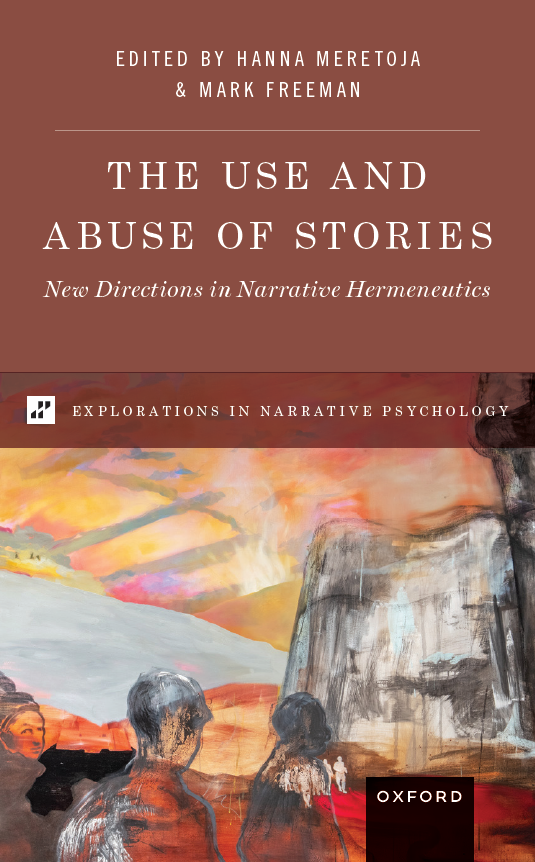
Narrative practice has come under attack in the current “post-truth” era. In fact, many associate “narrative hermeneutics”—the field of inquiry concerned with reflection on the meaning and interpretation of stories—directly with this putative movement beyond truth. Challenging this view, The Use and Abuse of Stories argues that this broad arena of inquiry instead serves as a vitally important vehicle for addressing and redressing the social and political problems at hand. Hanna Meretoja and Mark Freeman have gathered an interdisciplinary group of esteemed authors to explore how interpretation is relevant to current discussions in narrative studies and to the broader debate that revolves around issues of truth, facts, and narrative.
The contributions turn to the tradition of narrative hermeneutics to emphasize that narrative is a cultural meaning-making practice that is integral to how we make sense of who we are and who we could be. Narrative practice has come under attack in the current “post-truth” era. In fact, many associate “narrative hermeneutics”—the field of inquiry concerned with reflection on the meaning and interpretation of stories—directly with this putative movement beyond truth. Challenging this view, The Use and Abuse of Stories argues that this broad arena of inquiry instead serves as a vitally important vehicle for addressing and redressing the social and political problems at hand. Hanna Meretoja and Mark Freeman have gathered an interdisciplinary group of esteemed authors to explore how interpretation is relevant to current discussions in narrative studies and to the broader debate that revolves around issues of truth, facts, and narrative. The contributions turn to the tradition of narrative hermeneutics to emphasize that narrative is a cultural meaning-making practice that is integral to how we make sense of who we are and who we could be.
Addressing topics ranging from the dangers of political narratives to questions of truth in medical and psychiatric practice, this volume shows how narrative hermeneutics contributes to topical debates both in interdisciplinary narrative studies and in the current cultural and political situation in which issues of truth have gained new urgency.
Interpreting Violence: Narrative, Ethics, Hermeneutics (Routledge, 2023)
Cassandra Falke, Victoria Fareld & Hanna Meretoja (eds)
Representations of violence surround us in everyday life – in news reports, films and novels – inviting interpretation and raising questions about the ethics of viewing or reading about harm done to others. How can we understand the processes of meaning-making involved in interpreting violent events and experiences? And can these acts of interpretation themselves be violent by reproducing the violence that they represent?
This book examines the ethics of engaging with violent stories from a broad hermeneutic perspective. It offers multidisciplinary perspectives on the sense-making involved in interpreting violence in its various forms, from blatant physical violence to less visible forms that may inhere in words or in the social and political order of our societies. By focusing on different ways of narrating violence and on the cultural and paradigmatic forms that govern such narrations, Interpreting Violence explores the ethical potential of literature, art and philosophy to expose mechanisms of violence while also recognizing their implication in structures that contribute to or benefit from practices of violence.
Critical Approaches to the Storytelling Boom (Special Issue of Poetics Today, 2022, 43:2)
Maria Mäkelä & Hanna Meretoja (eds)
In this special issue, contributors argue that narrative studies can challenge the late capitalist storytelling industry to direct instrumental storytelling toward more ethically and rhetorically sustainable directions. Given this, the authors suggest, narrative studies should take a more prominent role in contemporary discourses of the storytelling boom. Seeking to redefine the role of narrative theorists and analysts in that boom, the authors address its critically different aspects while also showing how narrative studies can be made compelling, engaging, and societally relevant.
Cultural Memorial Forms (Special Issue of Memory Studies, 2021)
Eneken Laanes & Hanna Meretoja (eds)
A significant line of research in recent memory studies and narrative studies that has tried to locate and capture the movement between experiences and their individual and collective articulation and remembering has revolved around what we in this special issue propose to call cultural memorial forms. This special issue focuses on cultural memorial forms that, as it argues, illuminate the movement of memory between individuals and groups and provides a way of overcoming the dichotomy between memory ‘in the head’ and memory ‘in the wild’. It studies different cultural memorial forms such as genres, media, narrative templates, tropes, and conventionalised images in their transnational circulation and appropriation. It pays particular attention to the aesthetic media of memory that have a specific mode of circulation and are therefore uniquely situated between the individual and the social and cultural. In the current era of social media, in which cultural narratives are increasingly significant in shaping politics and economies, it is important to reflect on questions such as these: To the circulation of which memories and narratives do we contribute? Which cultural memorial forms do we take for granted and which ones are in need of critical questioning? We hope that this special issue, for its part, will contribute to such reflection on the possibilities and limits of cultural memorial forms and on the dynamics between individual and collective memory.
Engaging with Historical Traumas: Experiential Learning and Pedagogies of Resilience (Routledge, 2021)
Nena Mocnik, Ger Duijzings, Hanna Meretoja & Bonface Njeresa Beti (eds)
This book provides case-studies of how teachers and practitioners have attempted to develop more effective ‘experiential learning’ strategies in order to better equip students for their voluntary engagements in communities, working for sustainable peace and a tolerant society free of discrimination.
All chapters revolve around this central theme, testing and trying various paradigms and experimenting with different practices, in a wide range of geographical and historical arenas. They demonstrate the innovative potentials of connecting know-how from different disciplines and combining experiences from various practitioners in this field of shaping historical memory, including non-formal and formal sectors of education, non-governmental workers, professionals from memorial sites and museums, local and global activists, artists, and engaged individuals. In so doing, they address the topic of collective historical traumas in ways that go beyond conventional classroom methods.
Interdisciplinary in approach, the book provides a combination of theoretical reflections and concrete pedagogical suggestions that will appeal to educators working across history, sociology, political science, peace education and civil awareness education, as well as memory activists and remembrance practitioners.
The Routledge Companion to Literature and Trauma (Routledge, 2020)
Hanna Meretoja & Colin Davis (eds)
Literary trauma studies is a rapidly developing field which examines how literature deals with the personal and cultural aspects of trauma and engages with such historical and current phenomena as the Holocaust and other genocides, 9/11, climate catastrophe or the still unsettled legacy of colonialism.
The Routledge Companion to Literature and Trauma is a comprehensive guide to the history and theory of trauma studies, including key concepts, consideration of critical perspectives and discussion of future developments. It also explores different genres and media, such as poetry, life-writing, graphic narratives, photography and post-apocalyptic fiction, and analyses how literature engages with particular traumatic situations and events, such as the Holocaust, the Occupation of France, the Rwandan genocide, Hurricane Katrina and transgenerational nuclear trauma.
Storytelling and Ethics: Literature, Visual Arts and the Power of Narrative (Routledge, 2018)
Hanna Meretoja & Colin Davis (eds)
This book explores the philosophical and historical underpinnings of the postwar crisis and return of storytelling and demonstrates their relevance to the ongoing debate on the significance of narratives for human existence. It develops a framework that can be used to analyse the philosophical (ontological, epistemological, ethical, aesthetic) and cultural-historical underpinnings of different conceptions of narrative. It aspires to bring into dialogue narrative theory and the study of narratives in literary history.
Values of Literature (Leiden & Boston: Brill Rodopi, 2015)
Hanna Meretoja, Saija Isomaa, Pirjo Lyytikäinen, Kristina Malmio (eds)
Why we read literature and why we should read literature are age-old questions that have, in recent years, gained unprecedented scope and intensity, against the backdrop of what has been perceived as a world-wide crisis in the humanities. While scholars frequently discuss different types of value separately, in this volume values of literature are approached in the plural: we argue that the ethical, aesthetic, cognitive, affective, social, historical, and existential values of literature should be explored in connection with each other.
The three parts of the book explore the relationship between ethics and aesthetics; the cognitive, affective, and social values of literature; and the construction and questioning of literary values in society. Throughout the book, we discuss the different things literature can do – ranging from affirmation of social dogmas to its capacities for self-questioning and challenging of moral certainties – through the dynamic interplay of its ethical and aesthetic, cognitive and affective aspects. Literature not only reflects and draws on the values of the historical world from which it stems; it also actively addresses, challenges, and transforms those values and explores new ways to understand value. Through these complementary processes, literature engages in its own distinctively literary forms of value inquiry.
Proudly powered by WordPress

